The Situation
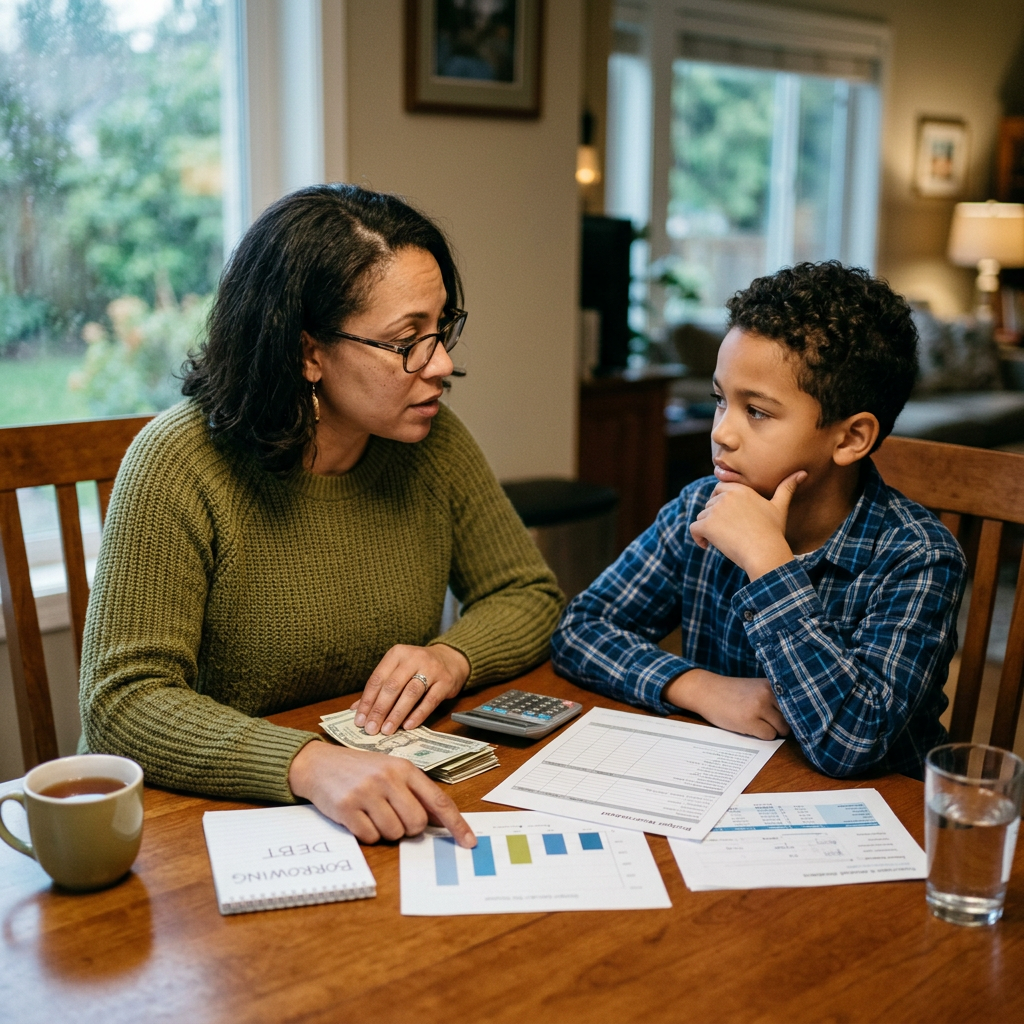
Your child spots your credit card, asks “Is that money?”, and suddenly you’re standing in the checkout line trying to explain what debt is — without making them panic or think your family is in trouble.
Or maybe they want something you can’t afford right now, and they suggest: “Just borrow money like Grandma does.”
Debt is everywhere — mortgages, car loans, credit cards, student loans — and kids notice it earlier than most parents expect. The problem is that most families never talk about it directly. Either it feels too adult, too stressful, or too complicated. So kids grow up either terrified of debt or completely unaware of how it works. Neither is helpful.
This article gives you the exact words to use — and the ones to avoid — when your child asks about borrowing money.
Why Parents Usually Get It Wrong
When a child asks about debt, most parents do one of three things:
- Shut it down: “That’s grown-up stuff, you don’t need to worry about it.”
- Overcomplicate it: A 10-minute lecture on interest rates and APR that loses the child at minute two.
- Accidentally scare them: “Debt is bad — never borrow money, ever.”
All three responses have unintended consequences. Shutting it down signals that money is a taboo topic, making kids less likely to ask questions as they get older. Overcomplicating it shuts down curiosity. And the blanket “debt is bad” message leaves kids unprepared — because some debt (a mortgage, a student loan with a solid plan) is a normal and sometimes smart financial tool.
The goal isn’t to protect your child from the concept of debt. It’s to give them an honest, age-appropriate picture of what borrowing money actually means.
The Better Approach
Start With the Simple Truth: Borrowing Means Paying Back More
Before any script, get this idea clear in your own head: debt is borrowing money now and paying it back later — usually with extra (called interest). That’s the core concept. Everything else is detail.
What to Say — By Age
Ages 5–7: Keep it concrete
Child: “What’s that card?”
Parent: “It’s a borrowing card. When I use it, the bank pays for things, and then I pay the bank back at the end of the month.”
Child: “So it’s free?”
Parent: “No — I still have to pay. It’s like borrowing a toy from a friend. You enjoy it now, but you have to give it back.”
At this age, the concept of “borrow and return” is enough. No need to introduce interest yet.
Ages 8–11: Add the cost of borrowing
Child: “Why don’t we just use the credit card for everything?”
Parent: “Great question. We can — but when we borrow money, we pay a little extra as a fee. So if I borrow $100 and don’t pay it back fast, I might end up paying $110 or more. That extra $10 goes to the bank for letting us use their money.”
Child: “So we pay more than what things cost?”
Parent: “Exactly. That’s why we only borrow when we have a plan to pay it back quickly.”
Ages 12–14: Talk about good debt vs. bad debt
Parent: “Not all debt is the same. Borrowing money to buy a house can make sense — because the house might be worth more later. Borrowing money to buy something you don’t need and can’t afford? That can get people into real trouble.”
Child: “What’s the difference?”
Parent: “Ask: does this debt help me build something, or does it just let me spend what I don’t have?”
What to Avoid Saying
- “We can’t afford it” with no follow-up — gives kids anxiety without context
- “Debt is always bad” — oversimplifies reality and shuts down future conversations
- “Don’t worry about money” — the opposite of what you want; kids should feel comfortable asking
The Teachable Moment
Debt conversations don’t have to wait for a crisis. Some of the best ones happen in ordinary moments:
- At the checkout: “I’m paying with my card today, which means I’m borrowing for a few weeks. But I already have the money saved to pay it back.”
- When a commercial for “buy now, pay later” comes on TV: “See that? They’re offering to lend you money — but you’ll pay more in the end. Good deal only if you’re careful.”
- When a sibling borrows from another: Use it as a mini-lesson. “How does it feel to wait for your money back? That’s what banks experience — which is why they charge interest.”
These micro-conversations do more than any sit-down lecture. The key is normalizing money talk so children see it as a topic, not a secret.
One concept worth planting early: debt is a tool, not a trap — if you use it intentionally. A hammer can build a house or break a window. The problem isn’t the hammer.
What If It Doesn’t Work?
If your child glazes over, changes the subject, or says “I don’t get it” — that’s completely normal. Debt is abstract. The brain needs repetition and real-life anchors to make it stick.
Try again in a different moment with a different angle. You don’t need to cover everything in one conversation. Think of it as a series of small deposits into their financial understanding — over months and years, not one afternoon.
If your child seems anxious after the conversation (especially if they picked up on stress around family finances), reassure them directly:
Parent: “I’m telling you this because I want you to understand how money works — not because we’re in trouble. We have a plan, and part of my job is to teach you these things so you’re ready when you’re older.”
One conversation won’t define their relationship with debt. Dozens of small, calm, honest ones will.
Quick Summary
- Debt = borrowing now, paying back more later — start with this simple frame
- Match the explanation to your child’s age: concrete at 5–7, add cost at 8–11, nuance at 12+
- Use real moments (credit card, sibling borrowing, TV ads) as entry points
Action item for this week: Next time you pay with a card or mention a bill, add one sentence: “This is money I borrowed — and here’s how I plan to pay it back.” That one sentence starts the conversation.
→ Related: Teaching kids about money by age | How to give kids an allowance that actually teaches something
 Kid Wealth Lab
Leave a comment