That moment is worth more than the purchase. When a kid wants to earn rather than receive, something important is shifting in how they see money. Your job now isn’t to find them a “job” — it’s to channel that energy into something real and age-appropriate.
Here are 10 ways kids actually make money, organized by age and effort level. No fake lemonade stands that lose $4 in lemons — just ideas that work.
Why Earning Matters More Than Getting
There’s a difference between a child who receives money and one who earns it. Research from the University of Michigan found that kids who learn to connect effort with income develop stronger financial responsibility as adults — not just better savers, but better earners.
Allowance teaches money management. Earning teaches something deeper: that money is created, not just handed out. That’s a mindset shift most adults still struggle with.
The goal isn’t just to give your child pocket money — it’s to give them a working model of how the world actually operates.
Ways to Make Money by Age Group
Ages 5–7: Simple, Supervised, Around the House
At this age, earning is mostly symbolic — the habits matter more than the amount. Keep tasks short, immediate, and tied to a visible result.
- Extra household jobs (beyond regular chores): Washing the car, sorting recycling, cleaning out a closet. Not everyday chores — those are family duties. These are extras they opt into.
- Selling art or crafts to family: Drawings, cards, painted rocks. Yes, grandma will overpay. That’s fine — it teaches the transaction.
- Helping neighbors with direct supervision: Watering plants, feeding a pet while someone is away.
Earning range: $1–5 per task. Keep it small and consistent.
Ages 8–11: Real Skills, Real Customers
This is when earning becomes genuinely productive. Kids this age can take on real responsibility and deliver real value.
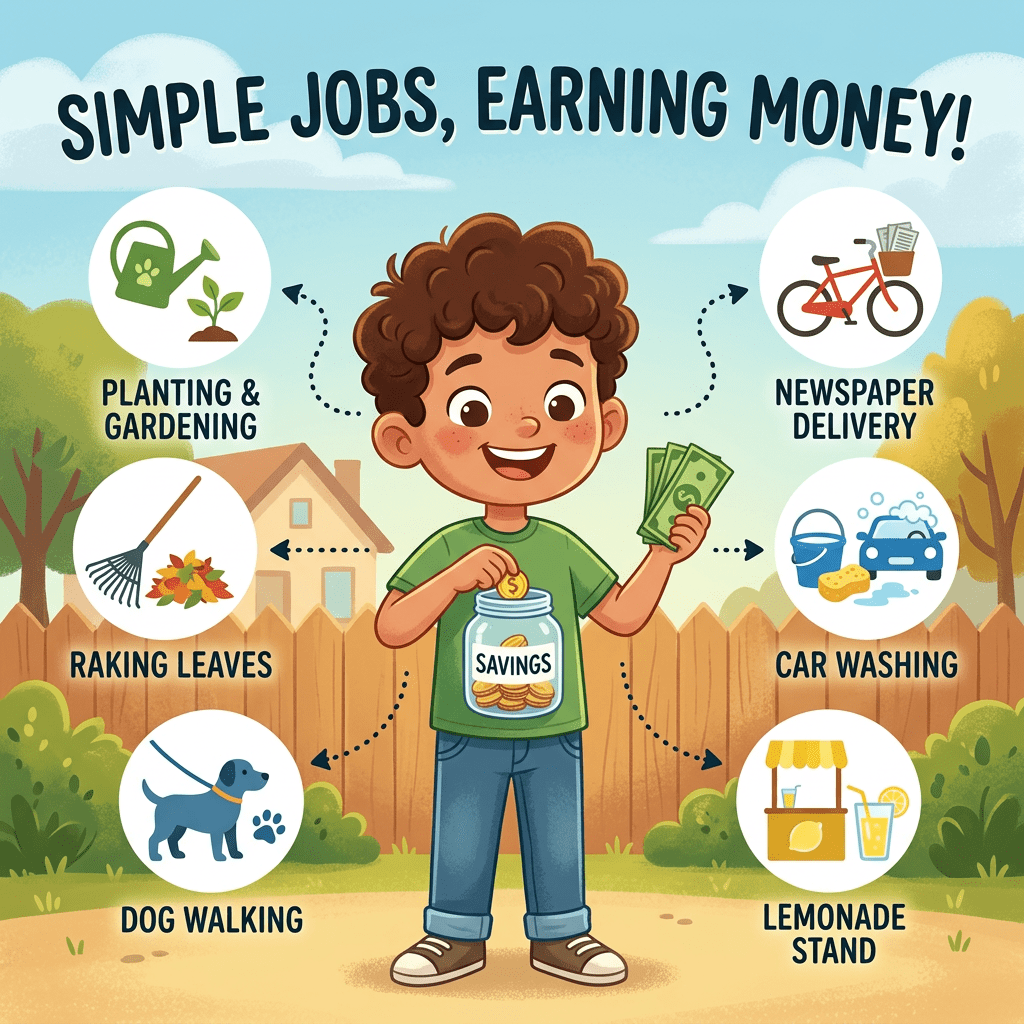
- Dog walking or pet sitting: One of the most reliable kid businesses. Word spreads fast in a neighborhood. A reliable 10-year-old with one regular client can earn $20–40/month.
- Lawn care: Raking leaves, watering gardens, basic weeding. Start with neighbors who already know your family.
- Kid-to-Kid selling: Decluttering their own toys, games, and books and selling them to other kids — at school, through a parent Facebook group, or at a local swap. This is one of the most powerful earning lessons: turning what you no longer value into money someone else will pay for.
- Baking and selling: Cookies, brownies, lemonade at a neighborhood spot. Teach them to calculate cost vs. revenue — even roughly. If ingredients cost $4 and they sold $10, they made $6.
Earning range: $5–25 per week with consistent effort.
Ages 12–14: Service-Based, Skill-Based
By 12, kids can offer services that genuinely help adults — and charge accordingly.
- Tutoring younger kids: A 7th grader who’s strong in math can tutor a 4th grader. Parents pay $10–15/hour for this. It also reinforces the tutor’s own knowledge.
- Tech help for adults: Setting up phones, fixing Wi-Fi, explaining apps. Most kids do this for free for family — teach them it’s a skill worth charging for with non-family.
- Photography or video for local events: Birthday parties, neighborhood events, school fairs. A decent phone and some basic editing is enough to start.
- Online selling (with parental account): Flipping items on eBay, Facebook Marketplace (under a parent’s account), Depop, or Poshmark. Buying low, selling higher — this is basic commerce.
Earning range: $20–100/month depending on hustle.
Ages 15–17: Near-Adult Income
- Part-time jobs: Retail, food service, library assistant. Most states allow work permits at 14–15.
- Freelance digital work: Social media management for a local small business, basic graphic design, writing, video editing.
- Teaching or coaching: Swimming, sports, music — if they’re skilled enough, they can teach younger kids.
Kid to Kid: Why Peer Selling Is One of the Best First Lessons
“Kid to kid” selling — where children sell things directly to other kids — is underrated as a financial teaching tool. Here’s why it works so well:
- The seller has to understand what another kid actually wants — that’s real market research.
- They set a price, negotiate, and close a deal — all without you stepping in.
- The feedback is immediate and honest. Other kids won’t buy something they don’t want just to be polite.
Practical ways to facilitate this:
- Garage sales or school fairs with their own table
- Posting in a parent Facebook group (with your account)
- Trading with friends — structured swaps where both sides feel they “won”
- Craft sales at a school market day
Before the first sale, ask your child: “What do you think kids your age would pay for this?” That one question teaches more about pricing than any textbook.
Real-Life Scenario: From Wanting to Earning
Nine-year-old Marcus wanted a $35 LEGO set. His parents said they’d match whatever he earned himself — up to $17.50.
He spent a Saturday going through his room, pulled out 12 toys he hadn’t touched in a year, and priced them using what he thought was fair. His mom helped him post them in a neighborhood group. He earned $22 in a weekend.
He bought the LEGO set with $17.50 of his own money (the rest stayed in his save jar). The important part wasn’t the toy — it was that he spent 45 minutes carefully choosing which LEGO set to get, reading reviews, comparing prices. He’d earned it, so he was careful with it.
That’s the behavior shift earning produces.
How to Start This Week
- Ask, don’t assign. “Do you want to earn some extra money?” works better than assigning a job they didn’t choose.
- Let them pick the method. A kid who chooses to walk dogs will do it better than one told to.
- Keep it simple the first time. One task, one clear payment, one result. Build from there.
- Don’t rescue the flops. If the lemonade stand loses money, resist the urge to make up the difference. That loss is the lesson.
Key Takeaway
The best way for a kid to make money isn’t the most obvious one — it’s the one that matches their age, their interests, and their current skill level. Start small, keep the money real, and let them feel the full cycle: effort → earning → decision → outcome.
Once a child earns their own money, how they spend it changes. That’s the real goal.
Want to teach your child what to do with the money they earn? Read The Three-Jar System: Teaching Kids to Spend, Save, and Give — it’s the structure that makes earning habits stick.
 Kid Wealth Lab
Leave a comment